
2 reasons why oats are gluten grains.
Aren’t oats naturally gluten free?

In a word, yes!
Oats in and of themselves do not contain gluten, thus are gluten free.
Read on to learn more about why they must be certified.
Why are oats included with ‘gluten grains’ in the UK list of notifiable allergens?
There are 2 reasons.
- Contamination: from harvest, transport, storage, milling, and making the finished product.
- It’s the protein: Gluten is the protein responsible for holding the product together, and is found in wheat, rye, barley, spelt, kamut, eincorn, triticale, and other ancient grains. Avenin, the protein in oats, has a very similar structure to gluten.
Let me explain
To fully understand the answers to the questions above, we must first understand something about the different grains, farming history, our words, and processing.
The different grains
Wheat
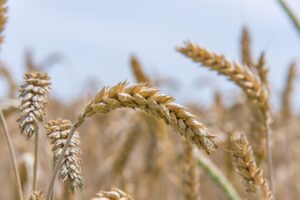
Wheat is widely used for making bread, pastries, cakes, biscuits, pasta, and sauces.
There are many different strains, grown for different products. For example Durum wheat is a very hard grain, very high in gluten, which is used to make pasta. The high gluten content will hold the shape of the pasta, so it doesn’t fall apart during processing and cooking.
For bread, the grain chosen has a lower strength of gluten. This is because we want a light, fluffy loaf of bread. Whilst it is the yeast that makes the bubbles, it is the gluten that holds them steady.
If you have ever made bread, you will know that the dough must be kneaded to bring out the gluten and you get a stretchy dough that cooks into a lovely loaf. If the gluten is not there, the bread will not rise, and you will have nothing more than a solid, inedible brick.
For cakes and pastries, yet a different strain of wheat will be chosen, with a gluten content that will hold the bubbles, but not go ‘chewy’.
As you can see, there are many different and very good reasons for different strains of wheat.
Rye

Rye is another hard grain which contains gluten.
The main ingredient of Whiskey or Whisky.
This is also used to make the very heavy ryebread or pumpernickel, but sometimes the fully ground flour may be combined with wheat to make a loaf of bread with a more dense texture.
Barley
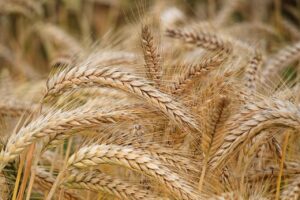
Barley is historically used to make beer.
Whilst beermaking is the most common use of barley, it will also be found as barley-malt, which will be found in many food products from yeast extract to confectionary and your soothing bedtime malted drink.
Oats
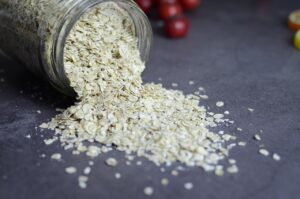
Oats are used for many different things, porridge, muesli or granola for breakfast, snack bars, flapjack, even as a substitute for milk.
Oats have long been promoted for some health benefits, because of their high fibre content and slow release carbohydrate. They are said to ‘keep you regular’, lower blood glucose, and even soften your skin, now I cannot vouch for any of those claims, because all they do for me is cause intense pain.
But what about oats and gluten?
Oats do not contain gluten. The protein in oats, called Avenin, has a very similar chemical structure to gluten, and it is possible for anyone who is sensitive to gluten to also have a reaction to this protein. This is the 2nd reason they are included in the list of notifiable allergens.
A history lesson
My Grandfathers were both tenant farmers, my Dad was a farm labourer, and my Uncle (Dad’s eldest brother) tenanted a small-holding.
They used to speak of bringing in the corn.
There is an old Harvest hymn, ‘Come, Ye thankful people, come’, where there is a line that goes, ‘First the blade, and then the ear, then the full corn shall appear.’
We can still hear country folk talking of field of corn.
People feed corn to their chickens.
What is corn?
To go back to that line, ‘the full corn’ means the ripe heads of grain, ready for harvest, and the term applied to all the grains, wheat, rye, barley, and oats.
You only need to do an internet search of ‘chicken feed’ to find sack of ‘Chicken Corn’ to see that it includes a mixture of grains including maize, wheat, and perhaps some other grains.
Today corn is taken to mean Maize or what we know as Sweetcorn, corn on the cob, or popcorn.
The conclusion of this point is that corn and grain are often used interchangeably, they can actually mean the same thing.
Contamination
Once again, I will return to the farming days of my ancestors.
Small farms would grow a field of wheat, another of rye, one of barley, and another of oats. They will often be harvested a few weeks apart, but the same equipment might be used, thus the high possibility of grains being mixed.
The same sacks, storage, transport and milling equipment may be used for all the crops. These are more examples of sources of contamination.
Other practices included:
- Rotational farming, where the crops are grown one year, followed by animals to eat the remaining stalks and any dropped grains, then arable crops again.
- Stubble burning, this is no longer allowed in the UK because of safety near roads and climate concerns, but, this meant setting fire to the fields after harvest. The stubble was burned to cleanse the fields, destroy any residual, dropped grains, and return the potassium to the ground ready for another crop.
We also have to realise that, as harvest time has a small window, trailers and silos may be used to transport and store different grains in succession, these are not the easiest things to clean, and it could be cost prohibitive to have dedicated facilities.
This is before we even have to think about managing cross contamination in a factory or kitchen!
Gluten free oats
To be certified as ‘gluten free’, oats must be farmed, stored, and processed completely on their own, with no possible contact with other grains.
Glebe Farm explain it much better than I can. In the following link, they explain the lengths they go to in guaranteeing their oats are gluten free.
What does it mean to be certified gluten free? – Glebe Farm
Remember though, gluten free means less than 20 ppm, so there could be 2mg per kilo, not a lot, but enough to make someone very poorly.
Find more about ‘How much is too much?’ here: How much is too much? – Food Allergy Friends
Labelling: Do gluten free oats need highlighting in the ingredients?
In short, the answer is ‘Yes’.
Oats are an allergen, therefore they must still be highlighted.
It is also not legal to label something that contains gluten free oats as ‘Free from the top 14 allergens.’.
The Food Standards Agency makes this quite clear in their document: Food Standards Agency Codes : alerts/def/allergen/oats-gluten-free

Wow, who knew. Thank you for your detailed explanation. Also the information regarding ancestors.